• Careers @ AMIS
  • About
  • News
  • Contact

Conclusion AMIS Technology Blog

Menu
  • Internet Of Things
  • Platforms
  • Microsoft Azure
  • Oracle Cloud

Home » SOA

SOA Suite 12c: Sharing resources between development environments: Export from and Import to Design Time SOA MDS repository image345

SOA Suite 12c: Sharing resources between development environments: Export from and Import to Design Time SOA MDS repository

Lucas Jellema June 27, 2014 SOA No Comments

The MDS repository is an important mechanism for SOA Suite 12c, both at design time during development as well as at run time. At design time, MDS is used to host shared resources such as WSDL and XSD documents that are referenced in many different places. Instead of copying these resources between applications and projects, or creating central shared folders that are managed manually and at file system level, MDS is concept that is native to JDeveloper and therefore much easier to use with these shared resources.

In SOA Suite 12c, a design time, file based MDS repository is part of the development environment – out of the box. You can create your own file based MDS repositories in addition to this out-of-the-box instance.

When you open the Resource window, under IDE Connections | SOA-MDS, you will find the connection to this local, file based repository – that is initially empty.
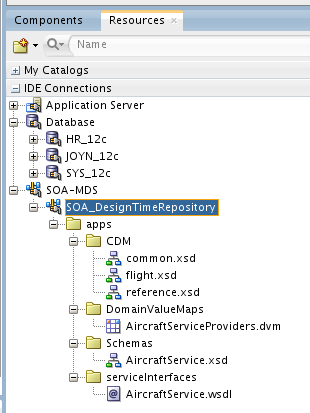
image

Resources can be added to the MDS, for example by transferring them from SOA composite or Service Bus projects. Resources can also be transferred from the MDS to Service Bus projects. I am not sure yet how to transfer resources from MDS to a SOA composite application.

However, as stated before, this out of the box file based design time MDS repository is local. Resources added to it, are not shared with MDS repositories in some other location. SOA composites that contain references that start with oramds: cannot be shared unless the sharing partners all have the referenced resources in their local MDS repositories. That’s why it is very convenient to be able to export selected resources from a design time file based MDS environment – to a jar-file – and import resources from this jar-file to MDS repositories in other environments. I just used this mechanism to bring resources across from one VM to another.

You can do it like this:

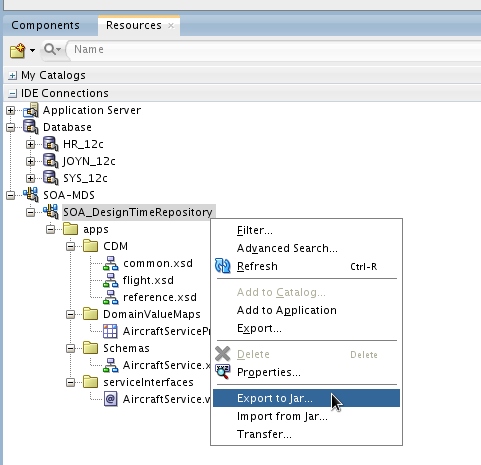
From the context menu on the relevant MDS connection, select Export to jar…
image

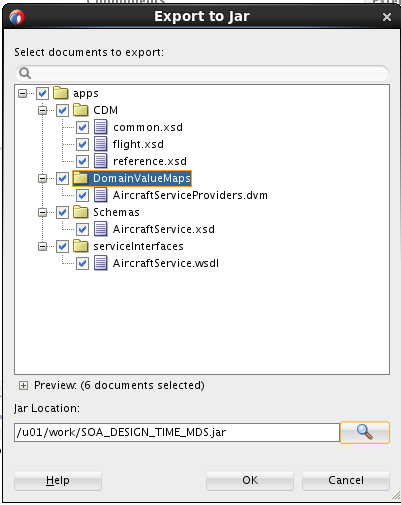
Selected which resources to export and specify the file name and location of the export archive:
image

Press OK to start the export operation – which is typically quite fast and produces fairly small files – all MDS resources are relatively small text-documents that compress very well.
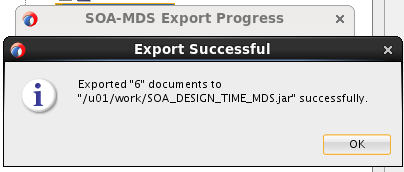
image

Importing resources from the export archive into another MDS instance is the reverse process, as you would expect:

From the context menu on the connection for the destination repository, select Import from Jar…
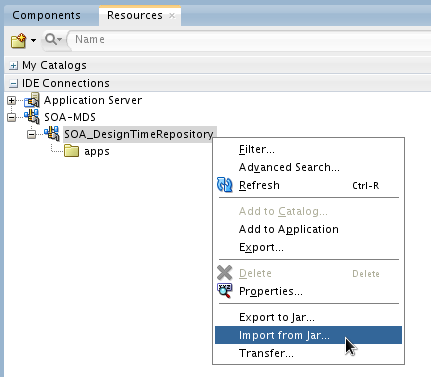
image

Specify the jar file to import from. JDeveloper will list the resources that are available for import and would specify any potential conflicts between the import archive and the existing repository content:
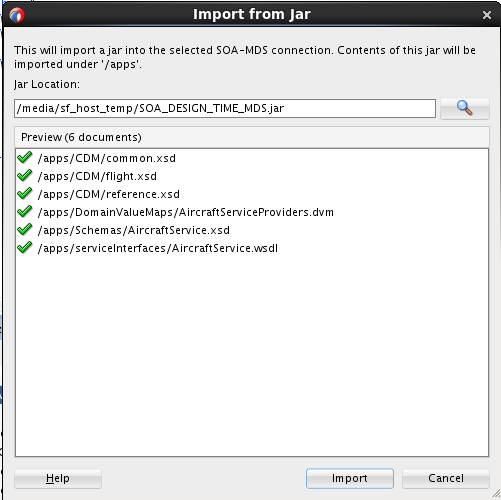
image

Press Import to transfer the resources.
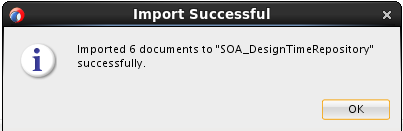
image

Press OK to conclude the operation.

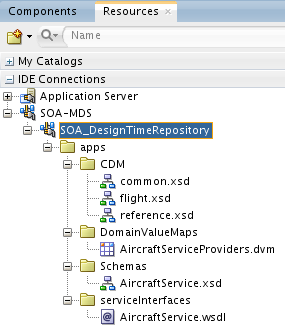
The Resource window now lists the updated MDS contents:
image

Resources

Oracle SOA Suite 12c Documentation – on Managing Shared Data with the Design-Time MDS Repository http://docs.oracle.com/middleware/1213/soasuite/develop-soa/soa-composite-design-mds.htm#SOASE88078

Share this:

  • Share on Bluesky (Opens in new window) Bluesky
  • Print (Opens in new window) Print
  • Share on LinkedIn (Opens in new window) LinkedIn
  • Share on X (Opens in new window) X
  • Email a link to a friend (Opens in new window) Email
  • Share on Telegram (Opens in new window) Telegram
  • Share on WhatsApp (Opens in new window) WhatsApp

Like this:

Like Loading...
Tweet Share WhatsApp Telegram

Related Posts

Oracle BPM Studio and Snow Leopard

Oracle BPM Studio and Snow Leopard

Session announcement: Oracle Service Bus (25 feb 2009)

Session announcement: Oracle Service Bus (25 feb 2009)

Skinning BPM Worklist & Humantasks

Skinning BPM Worklist & Humantasks

Tags:fusion middleware, jdeveloper, mds, metadata services, oracle soa suite

About The Author

Lucas Jellema

Lucas Jellema, active in IT (and with Oracle) since 1994. Oracle ACE Director and Oracle Developer Champion. Solution architect and developer on diverse areas including SQL, JavaScript, Kubernetes & Docker, Machine Learning, Java, SOA and microservices, events in various shapes and forms and many other things. Author of the Oracle Press book Oracle SOA Suite 12c Handbook. Frequent presenter on user groups and community events and conferences such as JavaOne, Oracle Code, CodeOne, NLJUG JFall and Oracle OpenWorld.

Lucas Jellema

Lucas Jellema, active in IT (and with Oracle) since 1994. Oracle ACE Director and Oracle Developer Champion. Solution architect and developer on diverse areas including SQL, JavaScript, Kubernetes & Docker, Machine Learning, Java, SOA and microservices, events in various shapes and forms and many other things. Author of the Oracle Press book Oracle SOA Suite 12c Handbook. Frequent presenter on user groups and community events and conferences such as JavaOne, Oracle Code, CodeOne, NLJUG JFall and Oracle OpenWorld.

View all posts
  • Java
  • Architecture
  • Big Data
  • Cloud
  • Continuous Delivery
  • Internet Of Things
  • Microsoft Azure
  • Platform Technology
  • Python

Bekijk onze Vacatures

Azure Integration Specialist Vacature AMIS

Contact us

Conclusion AMIS Technology Blog Copyright © 2026.
 
Manage Consent
To provide the best experiences, we use technologies like cookies to store and/or access device information. Consenting to these technologies will allow us to process data such as browsing behavior or unique IDs on this site. Not consenting or withdrawing consent, may adversely affect certain features and functions.
Functional Always active
The technical storage or access is strictly necessary for the legitimate purpose of enabling the use of a specific service explicitly requested by the subscriber or user, or for the sole purpose of carrying out the transmission of a communication over an electronic communications network.
Preferences
The technical storage or access is necessary for the legitimate purpose of storing preferences that are not requested by the subscriber or user.
Statistics
The technical storage or access that is used exclusively for statistical purposes. The technical storage or access that is used exclusively for anonymous statistical purposes. Without a subpoena, voluntary compliance on the part of your Internet Service Provider, or additional records from a third party, information stored or retrieved for this purpose alone cannot usually be used to identify you.
Marketing
The technical storage or access is required to create user profiles to send advertising, or to track the user on a website or across several websites for similar marketing purposes.
  • Manage options
  • Manage services
  • Manage {vendor_count} vendors
  • Read more about these purposes
View preferences
  • {title}
  • {title}
  • {title}
%d