
Steven Feuerstein wrote an entry on his Toadworld blog where he checks the refactoring capabilities of SQL-Developer.
I am trying the same things in PL/SQL Developer to see if this does do the trick.
First of all, a different couple of options are presented to you when you wrong click (or right click) a piece of highlighted code, depending on what you selected.
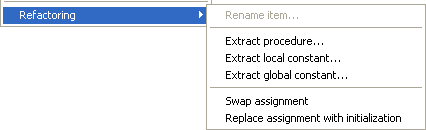
Let’s take the following code as our starting point:
create or replace procedure use_cursor (
security_level_in in pls_integer
, cursor_out in out number
)
authid definer
is
begin
cursor_out := dbms_sql.open_cursor(security_level_in);
dbms_sql.parse ( cursor_out
, 'select count(*) from all_source'
, dbms_sql.native
);
end;
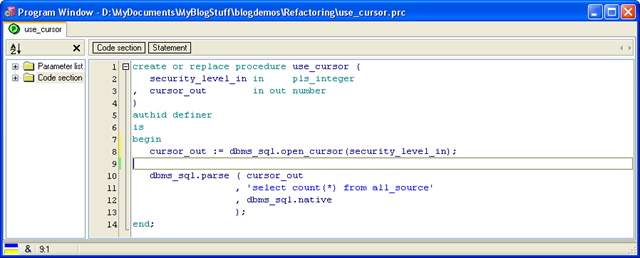
Now select the first line of the executable section of our code and choose ‘Extract procedure…’ from the popup menu:
We are now presented with the following dialog to name the new procedure:

After pressing the OK button, our code is changed to:
create or replace procedure use_cursor (
security_level_in in pls_integer
, cursor_out in out number
)
authid definer
is
-- Refactored procedure open_cursor_with_sl
procedure open_cursor_with_sl(security_level_in in pls_integer, cursor_out in out number) is
begin
cursor_out := dbms_sql.open_cursor(security_level_in);
end open_cursor_with_sl;
begin
open_cursor_with_sl(security_level_in, cursor_out);
dbms_sql.parse ( cursor_out
, 'select count(*) from all_source'
, dbms_sql.native
);
end;
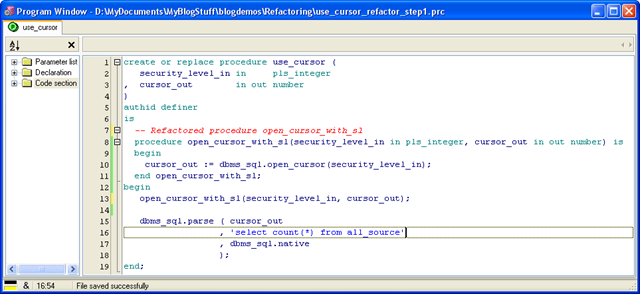
It seems to do it’s work like it’s supposed to. It even compiles, which makes it tested 😉
Now, let’s refactor some variable names. PL/SQL Developer wants you to highlight the first occurrence of the variable, for it to enable the ‘Rename item…’ option.
Using this code as a starting point:
create or replace procedure use_cursor (
security_level_in in pls_integer
)
authid definer
is
l_cursor number;
begin
l_cursor := dbms_sql.open_cursor(security_level_in);
dbms_sql.parse ( l_cursor
, 'select count(*) from all_source'
, dbms_sql.native
);
dbms_sql.close_cursor(l_cursor);
end;
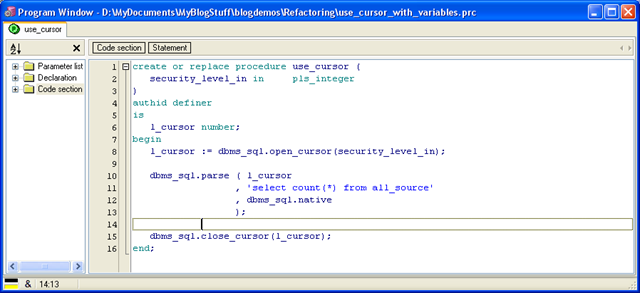
after selecting the first occurrence of l_cursor and selecting ‘Rename item…’ from the popup menu we are presented with the following dialog:
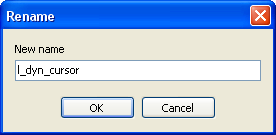
After typing in the new name of the variable, the code looks like this:
create or replace procedure use_cursor (
security_level_in in pls_integer
)
authid definer
is
l_dyn_cursor number;
begin
l_dyn_cursor := dbms_sql.open_cursor(security_level_in);
dbms_sql.parse ( l_dyn_cursor
, 'select count(*) from all_source'
, dbms_sql.native
);
dbms_sql.close_cursor(l_dyn_cursor);
end;

Now, let’s add a reference to a package variable with the same name as we just changed the variable to:
create or replace procedure use_cursor (
security_level_in in pls_integer
)
authid definer
is
l_dyn_cursor number;
begin
l_dyn_cursor := dbms_sql.open_cursor(security_level_in);
dbms_sql.parse ( l_dyn_cursor
, 'select count(*) from all_source'
, dbms_sql.native
);
dbms_sql.close_cursor(l_dyn_cursor);
my_package.l_dyn_cursor := 10;
end;

When the ‘Rename item…’ option is selected, the same dialog is displayed as before (makes sense, we are doing pretty much the same thing):

After the refactoring the code looks like this:
create or replace procedure use_cursor (
security_level_in in pls_integer
)
authid definer
is
l_dyn_cursor2 number;
begin
l_dyn_cursor2 := dbms_sql.open_cursor(security_level_in);
dbms_sql.parse ( l_dyn_cursor2
, 'select count(*) from all_source'
, dbms_sql.native
);
dbms_sql.close_cursor(l_dyn_cursor2);
my_package.l_dyn_cursor := 10;
end;
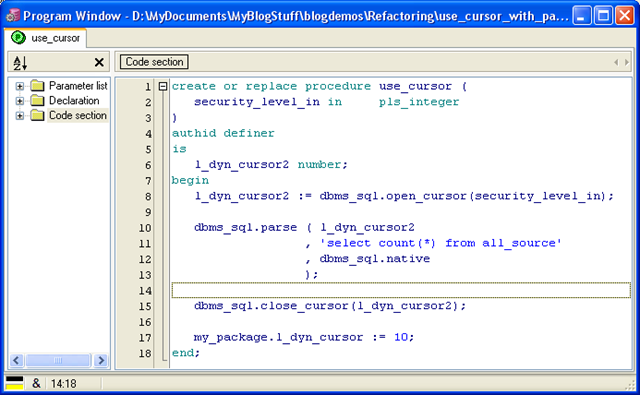
As you can see, it didn’t touch the variable from the package, even though it has the same name as the variable being refactored. There is no option to change the case of the selection, but I have to agree with Steven on this one, that’s no real refactoring, more a layout issue.
(This entry is cross-posted at http://blog.bar-solutions.com)
